Quick Answer
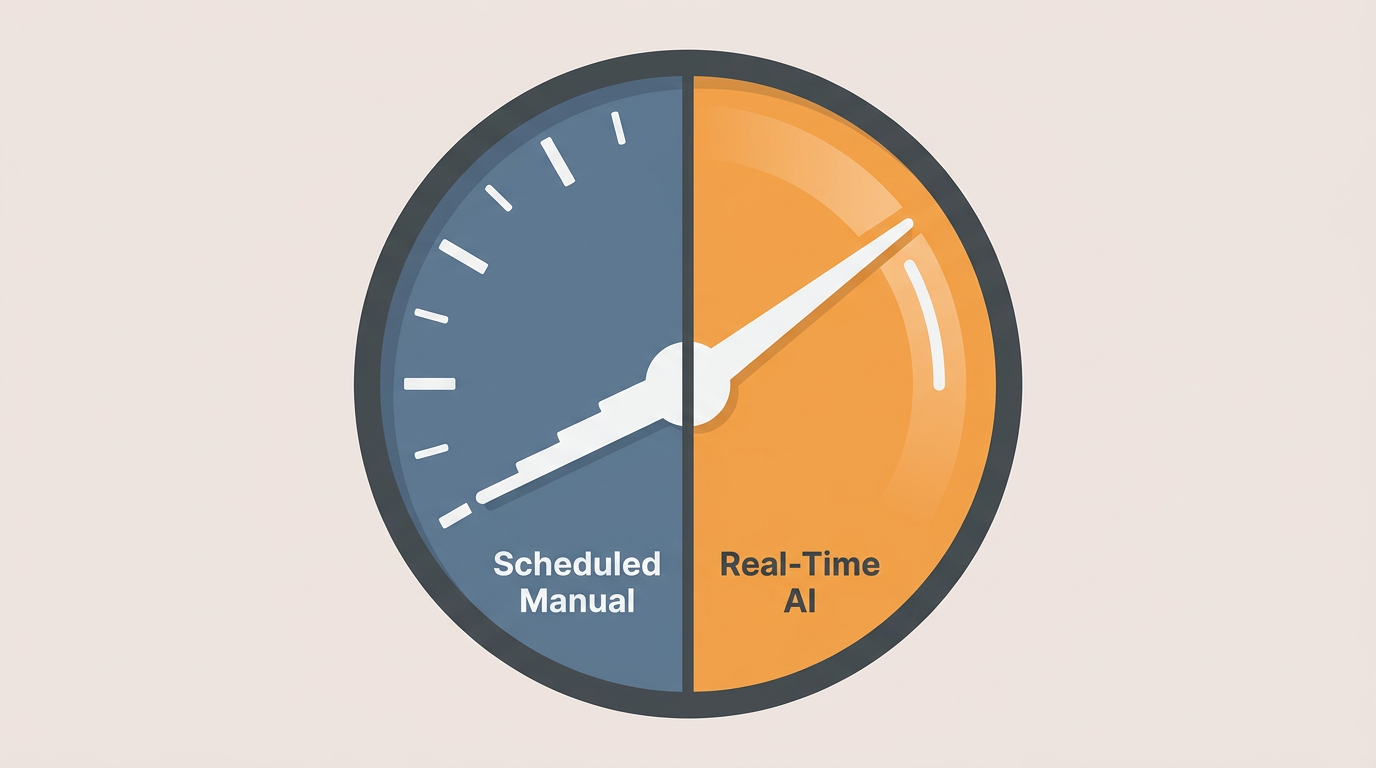
Real-time AI optimization sets bids at auction time, using a combination of signals that no person could evaluate manually at the same scale. Scheduled manual adjustment changes bids on a human review cycle, often weekly, using business judgment that automated bidding may not be able to capture directly.With sufficient conversion volume and clean tracking, AI bidding has a clear advantage in speed and signal processing. Below Google's recommended evaluation volume, or when conversion tracking is unreliable, greater human oversight may be safer. Most mature teams run both: the algorithm sets the bids, and people set the limits.
Key Takeaways
Google Ads Smart Bidding can set bids at auction time using a wide range of contextual signals. A weekly manual review, by contrast, changes bids only a handful of times each month.
The real cost of manual bidding is not effort. It is latency, and latency can be measured.
Google recommends evaluating Smart Bidding over periods with at least 30 conversions, or 50 for Target ROAS, to get a more reliable read on performance
Changing bid strategies can introduce a period of performance fluctuation, and the time required to stabilize depends on conversion volume and conversion-cycle length.
Handing over bids does not hand over accountability. Budget limits, alerts and a kill switch stay with you.
The Real Variable Is Decision Latency, Not AI Versus Human
Most comparisons argue about intelligence. That is the wrong axis. The machine does not replace your PPC manager's business judgment. It cannot independently understand a contract, weigh a brand risk, or know that a warehouse is about to run out of stock unless that information is incorporated into the system.
What it does have is dramatically lower decision latency.
Decision latency is the gap between a market change and your response to it. Auction-time optimization can react within the bidding process itself, while a weekly manual review can leave a change unaddressed for several days.Everything else in this comparison follows from that one number.
The same gap shows up elsewhere in the funnel. It sits between deciding to run a campaign and having it live, which is the case for autonomous campaign execution rather than a bidding problem.
What Real-Time AI Optimization Actually Does
Bidding At Auction Time
When someone searches, an ad auction determines which ads are eligible to appear and how they are positioned. Auction-time bidding works out the bid for that auction, that person and that moment. It does not reach for a number you set last week.
Google's help pages say Smart Bidding "uses machine learning to set millions of unique bids every second." It predicts the conversion rate for a click in each auction from the signals in front of it How Google Ads Calculates Bids
This is the engine behind algorithmic bid management, and a manual process cannot copy it. Not because people are slow at arithmetic, but because no human workflow reaches every auction.
Google lists device, location, time of day, day of week, list membership, browser and search query among the signals open at auction time About Smart Bidding . You can respond to some of these signals manually, but no human workflow can evaluate the full combination at auction scale.
Example: you can set a mobile bid modifier. You cannot set one for a mobile user in Manchester, on a Thursday evening, already on your remarketing list, typing a long-tail query. The value sits in that overlap.
What It Will Not Fix
Real-time AI does not fix a weak offer or a poorly converting landing page. It does not repair broken conversion tracking; inaccurate conversion data can instead lead Smart Bidding to optimize toward the wrong outcome at scale.
An algorithm can optimize efficiently toward the wrong target if the underlying conversion data or goal is wrong.
Getting those inputs right is the unglamorous work behind improving ROAS on Google, and no bid strategy substitutes for it.
Example: a retailer counts newsletter sign-ups and orders as the same conversion. Smart Bidding buys sign-ups all day, because they are cheaper and more frequent.
What Scheduled Manual Bid Adjustments Actually Do
Manual bidding means a person opens the account on a fixed rhythm and moves bids or modifiers. The number of bid decisions depends on the review cadence, but a weekly process typically means only a handful of manual bid changes each month.
The Judgment A Model Does Not Have
A bid strategy aims at the goal you gave it, using the data it can see. It has no field for most of what decides whether a click is worth buying: margin by product, contract value, stock position, a recall, a partnership.
Some of this can be fed in. Margin data can be passed as conversion values, which is what teams working toward return on ad spend already do. Much of it may not be available to the bidding system in a timely or actionable form.
When Manual Is Really A Set Of Rules
Many teams who call their process manual are running scripts: pause a keyword above a cost limit, raise bids on Fridays, cut spend when stock runs low.
That is automation of a different kind: rule-based, predictable, and limited by the conditions and thresholds defined in advance. It can inherit weaknesses from both approaches, executing automatically but reacting only to conditions that someone anticipated when the rules were created.We cover the split in AI agent vs rule-based campaign automation.
Example: a script that pauses keywords above a cost limit keeps firing through a sale week, when the higher cost was expected and profitable.
Bid Frequency, Control And Risk: The Nine Criteria That Decide This
Decision Criterion | Real-Time AI Optimization | Scheduled Manual Adjustments |
|---|---|---|
Decision frequency | Every auction | 4–30 times a month |
Signals used | Multiple contextual signals | Aggregate reports and human judgment |
Data needed to start | Google recommends evaluating periods with at least 30 conversions, or 50 for Target ROAS | No specific conversion-volume threshold |
Time to a reliable read | Depends on conversion volume and conversion cycle | Depends on review cadence and data volume |
Cost of one mistake | Can accumulate quickly if the underlying signal is wrong | Can accumulate until the next review |
Speed of a fix | Can respond at auction time | Depends on review cadence |
Audit trail | Outcome-focused; individual bid decisions may not be visible | Traced to a person and a date |
Staffing cost | Low to run, higher to set up | Grows with each new account |
Reach across channels | One platform, unless a layer sits above it | Fragmented across platform interfaces |
How Latency Multiplies A Small Error
Budget size is only half the story. What sets the cost of latency is how much spend runs through the error before anyone notices.
A weekly review leaves up to 168 hours of drift. A daily check leaves up to 24. An auction-time system leaves less than one. The implication is straightforward: for the same underlying mistake, a slower review cycle can expose substantially more spend before the issue is detected and corrected.
The exact financial impact depends on spend, volatility, and how quickly the issue is identified.. That is our own calculation from the review windows, not a published benchmark.
Volatility matters more than scale. A steady account whose costs barely move loses little to a slow rhythm. A market with price-driven rivals and sharp intraday demand loses something every day, at any budget.
When Scheduled Manual Adjustments Still Win
Below The Data Floor
Machine learning needs examples. Google advises judging results "over longer time periods that have at least 30 conversions, such as a month or longer (50 conversions for Target ROAS)" (Google Ads Help, About Smart Bidding).
Below that level, performance can be more volatile and the available signal may be less reliable for evaluating the strategy.Where appropriate, consolidating campaigns can help pool conversion data and provide the bidding system with a stronger signal.
Example: an account with eight conversions a month splits them across six campaigns. Merging into one gives the model something to learn from.
Long Or Uneven Sales Cycles
Enterprise sales with a nine-month cycle create a structural problem. The conversion may occur long after the original click, creating a longer feedback loop that can make optimization and performance evaluation more difficult.
The fix is to aim at a qualified lead or another mid-funnel signal, then check that the proxy still tracks real revenue through incrementality testing.
When Your Conversion Data Is Wrong
Conversion-data problems are a major risk for automated bidding, and the issue often lies in the underlying data rather than the bidding algorithm itself.
Duplicate conversion actions, broken tags, or delayed offline data can distort the signals used by Smart Bidding and lead it to optimize toward the wrong outcome.
Google says to apply data exclusions as soon as you spot a tracking problem, but warns that you "shouldn't use data exclusions frequently or for prolonged periods, as this can negatively impact Smart Bidding performance" (Google Ads Help, About Data Exclusions).
Example: a tag fires twice on the thank-you page. The model sees double the conversions, reads the campaign as twice as efficient, and bids up.
The Switching Cost Nobody Prices
Changing bid strategy is not free, and most migration plans leave this out.
Google recommends allowing sufficient time for Smart Bidding to adjust after significant changes, with performance often best evaluated after at least one conversion cycle and, in some cases, one to two cycles.
How long depends on conversion volume, cycle length and the strategy you pick Duration Of The Learning Period.
Three weeks of unstable results is a real cost, and a recurring one for teams that retune targets on instinct.
Frequent changes can make performance harder to evaluate because the strategy may not have enough time to stabilize before another change is introduced.
The Hybrid Model: Automation Inside Human Limits
The choice between AI and manual is a false one. The mature setup is automation inside limits a person owns. That division of labour is the pattern running through AI in performance marketing generally, not just in bidding.
Who Sets The Bid And Who Sets The Limit
The algorithm determines bids at auction time and continuously responds to available signals and changing performance conditions within the constraints of the strategy. The advertiser still controls the business inputs and guardrails that matter most:
Budget limits
Target cost per acquisition, or return on ad spend
What counts as a conversion, and what it is worth
Audience and placement exclusions
Campaign structure and channel mix
Creative and landing pages
These controls define the boundaries within which the algorithm operates. That is why AI budget allocation is a governance decision, not a technical one.
The Operating Routine That Keeps Automation In Check
Stopping manual bids does not free up the calendar. It changes what goes in it:
Daily — pacing, cost breaches and disapprovals. Campaign manager.
Weekly — targets against unit economics, search terms, creative. Marketing lead.
Monthly — structure, budget shifts, channel mix. Marketing director.
Quarterly — incrementality testing, to confirm the gains are real. Marketing and finance.
The daily check is not manual bidding; it is monitoring and governance, which remain important even when bid decisions are automated.
That routine only holds if the limits around it are set first. Set a hard budget ceiling that limits the financial impact of an unexpected performance problem.
Route cost and spend-velocity alerts to a named owner who is responsible for reviewing and acting on them. Give each campaign group an owner. Write down the rollback: which strategy you revert to, and who may trigger it.
Agree a review window after any change, when unstable results are expected and not acted on.
Within that frame, scheduled intervention keeps one clear role: telling the model about a future it cannot infer from the past.
Google recommends seasonality adjustments for short events when a significant temporary change in conversion rates is expected; its guidance identifies 1–7 days as an ideal duration and notes that they may be less effective when used for longer periods. (Google Ads Help, About Seasonality Adjustments). A three-day sale qualifies. A quarter-long push does not.
Who Is Accountable When The Algorithm Is Wrong
This is one of the questions that should be answered before automated bidding is given greater control over spend
Handing over a decision does not hand over responsibility for it. When automated bidding drifts, the answer cannot be that the algorithm did it.
Someone still owns the target, budget limit, conversion definition, and governance framework that shape the algorithm's decisions.
Answer three questions before you hand over a budget. What is the most a bad day can cost? How fast will we know? Who can stop it, and how quickly?
Example: a board asks why spend rose 40% in a week. You cannot show the reasoning behind any single bid. You can show the target, the budget limit, the alert log and the response time. That is what a control environment looks like.
The Cross-Channel Gap Platform Bidding Leaves Open
Real-time bidding is native to each platform, and each one optimises only inside its own inventory. Google's bidding system does not automatically optimize against the performance of your LinkedIn campaigns or other external channels.
That leaves one decision no auction-time algorithm makes: how much budget each channel should hold. Neither platform can move budget to the other, so a person seeing both in one view has to. It is the real difference between cross-channel AI orchestration and native tools alone.
Making that call on time depends on cross-channel campaign performance monitoring that reports across Meta, Google, LinkedIn and TikTok in one place. Without it, the comparison happens once a month in a spreadsheet, if it happens at all.
Frequently Asked Questions
Can Real-Time AI Bidding Beat A Skilled Manual Bidder?
On auction-level speed and the breadth of signals it can process, automated bidding has a clear advantage. A person cannot price millions of auctions a second. On strategy, and on knowing what a customer is worth, a skilled marketer stays ahead. The best results combine both.
How Much Conversion Data Do I Need Before Automation Works?
Google asks for periods with at least 30 conversions, and 50 for Target ROAS.Below that level, consider whether campaign consolidation or a higher-volume, meaningful conversion action could provide a stronger signal.
How Often Should I Still Adjust Bids Manually?
Once real-time optimization is running, stop adjusting individual bids. Review your targets weekly against unit economics, and apply scheduled adjustments only for known short events such as a sale or a launch.
What Is the Biggest Risk of Automated Bidding?
Aiming efficiently at the wrong objective. A model fed inaccurate conversion data can optimize efficiently toward the wrong outcome. Data quality, not model quality, is the usual failure point.
Can I Run Automated Bidding Across Google, Meta And LinkedIn Together?
Each platform bids independently, inside its own inventory. To move budget between them you need a layer that sits above the platforms.
Bottom Line
With sufficient conversion volume, reliable tracking, and well-defined goals, real-time AI optimization can outperform a scheduled manual bidding process because it can respond to auction-level signals without waiting for the next human review.
Below the data floor, or under constraints a bid target cannot express, keep manual control until that changes. Either way, the budget limits, targets and kill switch stay with a named person.
Book a demo to see cross-channel optimization with the control layer intact.