Performance marketing used to be relatively straightforward: choose an audience, launch campaigns, monitor CPA or ROAS, and optimize the account.
That model is getting harder to sustain.
Today, marketing teams are dealing with more channels, more creative formats, fragmented customer journeys, privacy-related measurement gaps, and increasingly complex advertising platforms. At the same time, platforms such as Google and Meta are already using AI to automate parts of targeting, creative optimisation, bidding, and delivery. Google, for example, has expanded AI-powered capabilities in Search through AI Max, while Meta continues to use large-scale AI systems across its advertising infrastructure.
The next shift is not simply using AI to analyse performance.
It is using AI agents to act on performance signals.
An AI agent can monitor data, identify an opportunity, form a hypothesis, execute a change, observe the result, and feed that learning back into the next decision. That is fundamentally different from a dashboard that simply tells a marketer what happened. NYX also explores this shift in how enterprise marketing teams are using AI agents for Google and Meta Ads.
For CEOs, founders, CMOs, marketing directors and growth leaders, the important question is therefore not:
“Where can we add AI to marketing?”
It is:
“Which parts of the performance marketing system can AI continuously operate and improve?”
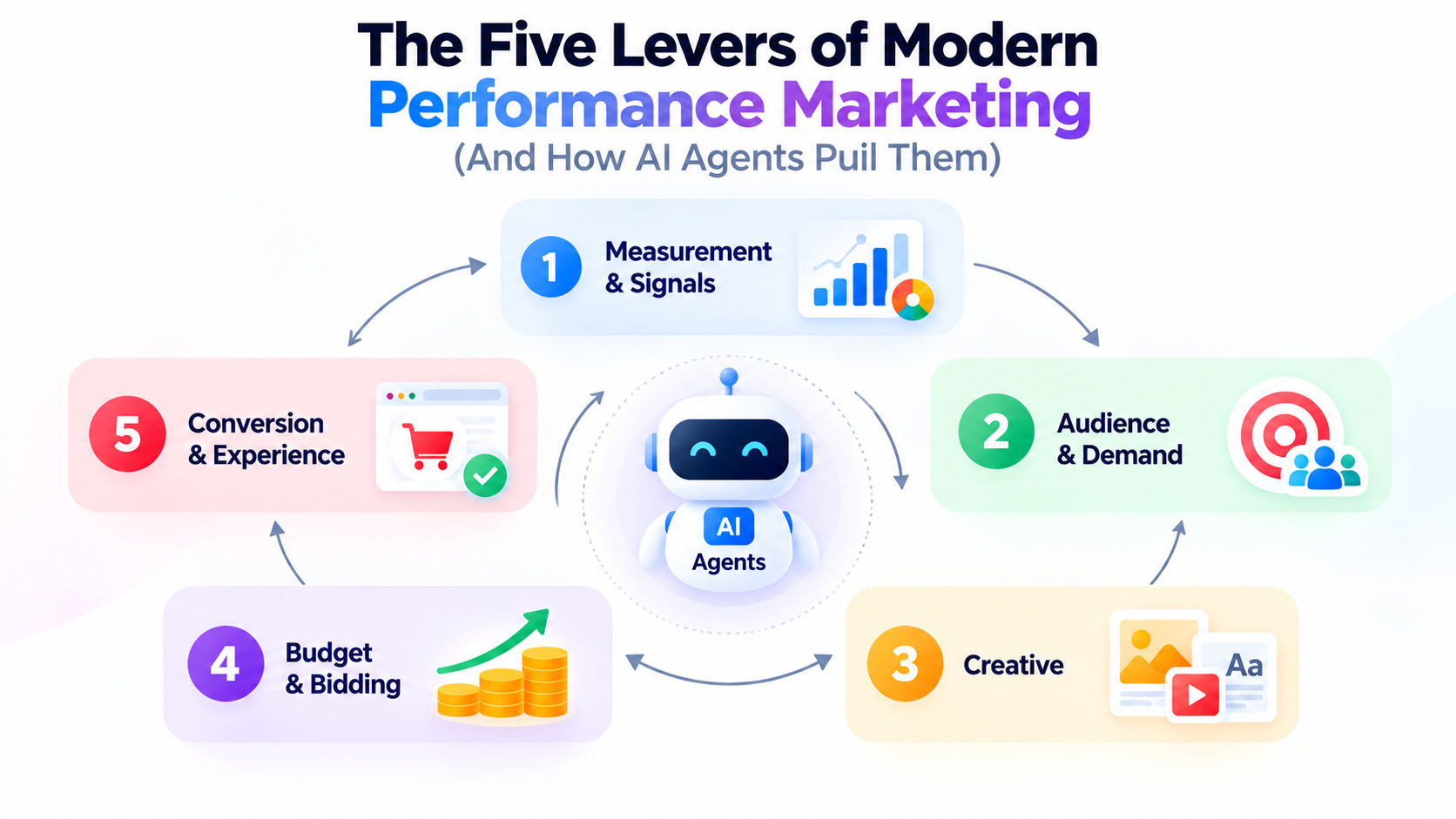
A useful way to answer that is through five core levers:
Measurement & Signals
Audience & Demand
Creative
Budget & Bidding
Conversion & Customer Experience
When these five levers work together, performance marketing becomes less about manually managing campaigns and more about managing an intelligent growth system.
What are the five levers of performance marketing?
The five levers represent the major areas that influence paid-growth performance.
Lever | Core question | What AI agents can do |
Measurement & Signals | Are we measuring the right outcomes? | Monitor data quality, identify anomalies and reconcile performance signals |
Audience & Demand | Are we reaching the right potential customers? | Analyse intent, segments, search behaviour and audience signals |
Creative | Are we giving customers a reason to act? | Generate, test, analyse and refresh creative variations |
Budget & Bidding | Where should the next rupee go? | Reallocate budgets, adjust bids and identify scaling opportunities |
Conversion & Experience | What happens after the click? | Detect funnel friction, personalise experiences and trigger follow-ups |
The key is that these levers are connected.
Better measurement improves audience decisions. Better audience signals inform creative. Creative performance influences budget allocation. Budget decisions affect the volume of conversion data. Conversion data then improves the entire system.
AI agents can potentially operate across that loop instead of treating each task as a separate workflow.
1. Measurement & Signals: Give AI Something Worth Optimising
Suggested image: AI monitoring conversion quality, revenue and attribution signals.
The first lever is also the one that is easiest to overlook.
AI is only as useful as the signals it receives.
If a company is optimising toward the wrong conversion event, incomplete customer data or misleading attribution, automation can make the problem worse by making incorrect decisions faster.
For example, imagine an e-commerce company optimising campaigns for "Add to Cart" because its purchase tracking is broken.
An AI system may find increasingly efficient ways to generate add-to-carts.
The business may still generate very few sales.
That is why modern performance marketing starts with measurement.
Google describes attribution as the process of assigning credit to different ads, clicks and marketing interactions along a customer's path to a meaningful action. Google Ads attribution documentation provides further detail. Its data-driven attribution approach uses both converting and non-converting paths to estimate how different interactions contribute to outcomes.
What should businesses measure?
Depending on the business model, useful signals can include:
Qualified leads
Purchases
Revenue
Contribution margin
Customer acquisition cost
Customer lifetime value
Subscription starts
Repeat purchases
Pipeline value
Offline sales
Lead-to-sale conversion rate
The goal is to move beyond platform metrics and connect advertising activity to actual business outcomes.
Where AI agents fit
A measurement agent could continuously:
Check whether conversion events are firing correctly
Detect sudden changes in conversion volume
Compare platform-reported conversions with CRM or backend data
Identify unusual spikes in CPA or drops in conversion rate
Flag tracking discrepancies
Monitor attribution changes
Surface campaigns that are optimising against weak signals
This does not eliminate the need for human oversight.
It creates an automated measurement quality-control layer.
Google's Enhanced Conversions product is one example of the broader direction: using additional consented first-party information to improve conversion measurement and support automated bidding. See Google Ads Enhanced Conversions.
Executive takeaway
Before asking AI to optimise advertising, ask:
“Are we giving it a reliable definition of success?”
If the answer is no, fix the signal before increasing automation.
2. Audience & Demand: Find Where Intent Is Moving
Suggested image: AI identifying audience intent and emerging demand patterns.
The second lever is understanding who is likely to buy, why they might buy, and when demand is emerging.
Traditional audience planning often relies on predefined segments:
Age
Gender
Location
Interests
Demographics
Lookalike audiences
Keyword groups
These still have value, but advertising platforms increasingly use machine learning to identify patterns that marketers cannot manually define.
Google's AI Max for Search, for example, uses AI-powered search-term matching and other signals to expand reach beyond manually specified keyword structures. See Google Ads AI Max for Search campaigns.
The implication is important:
The marketer's job is gradually shifting from manually defining every audience to defining the business constraints and signals the system should optimise around.
What an audience agent could do
An AI agent could monitor:
Search-term trends
Customer segments
Website behaviour
CRM data
Product interest
Geographic performance
Lead quality
Purchase behaviour
Audience overlap
Emerging demand patterns
It could then identify patterns such as:
“Customers from this segment have a 22% higher purchase rate but are receiving significantly less budget.”
Or:
“Search demand for this product category has increased, but campaign coverage has not.”
The agent's value isn't simply identifying the segment.
It is connecting demand signals to an action.
Example
Suppose a SaaS company sells software to mid-sized businesses.
Its campaign data shows that leads from companies with 50–200 employees have a lower volume but a significantly higher demo-to-opportunity rate.
A traditional dashboard reports the difference.
An agent could go further:
Detect the segment.
Compare lead quality against acquisition cost.
Identify the campaigns producing those leads.
Recommend or execute budget adjustments within predefined limits.
Generate new creative messaging around the segment's specific pain points.
Monitor whether downstream pipeline quality improves.
That's the difference between analytics and agentic optimization.
3. Creative: Turn Advertising From a Production Bottleneck Into a Testing System
Suggested image: Analyse → Generate → Test → Learn → Refresh.
Creative may be the most visible performance lever. NYX also covers AI ad creative development and how AI can support creative production and testing.
But the bigger change is not simply that AI can generate ads.
It is that AI can help create a continuous creative testing loop.
Modern advertising platforms are already highly automated on the targeting and delivery side. That makes the quality, variety and relevance of creativity increasingly important.
Google's AI Max, for example, includes AI-powered asset optimisation and text customisation. Meta also provides AI-powered creative capabilities through Advantage+ creative, including automated creative adjustments.
A strong creative system should answer four questions:
What message is working?
For whom?
In which format?
Why?
An AI creative agent can potentially manage the loop
Analyse → Generate → Test → Learn → Refresh
For example:
Analyse
Identify which hooks, formats, offers and messages are producing stronger conversion rates.
Generate
Create new variations based on the patterns that are working.
Test
Put different concepts into controlled campaigns.
Learn
Determine which creative characteristics correlate with better outcomes.
Refresh
Generate the next round of concepts instead of allowing winning creative to become stale.
This creates a compounding learning loop.
But more creative does not automatically mean better creative
One common mistake is to measure AI's creative value by the number of assets it can produce.
That is the wrong metric.
A company does not need 500 mediocre ads.
It needs a system that can discover which creative ideas deserve more investment.
Human input remains particularly important for:
Brand positioning
Emotional storytelling
Cultural context
Legal and regulatory review
Product claims
Brand safety
Strategic messaging
Meta has also introduced transparency measures for ads created or significantly edited using its generative AI tools, reinforcing that AI-generated creative still sits within a broader governance framework.
Executive takeaway
The advantage of AI is not:
“We can make more ads.”
It is:
“We can learn faster which ideas deserve more media investment.”
4. Budget & Bidding: Move Money Based on Evidence
Suggested image: AI reallocating budget based on marginal return and performance signals.
The fourth lever is where performance marketing becomes directly connected to capital allocation.
Every marketing team eventually faces the same question:
Where should we spend the next ₹1?
Historically, marketers have answered this through periodic reviews:
Weekly campaign optimisation
Monthly budget meetings
Manual bid changes
Spreadsheet analysis
Performance reports
Agency recommendations
The problem is that advertising auctions do not wait for the Monday meeting.
Performance can change throughout the day.
AI systems are well suited to monitoring these high-frequency signals.
Google's advertising ecosystem already uses automated bidding and AI-driven optimisation, while newer products such as AI Max add further automated targeting and creative optimisation capabilities. See Google Ads Performance Max.
What an AI budget agent could monitor
CPA
ROAS
Conversion volume
Marginal return
Budget utilisation
Auction changes
Creative fatigue
Geographic performance
Product-level performance
Day-of-week patterns
Funnel quality
The important phrase here is marginal return.
A campaign producing a 4x ROAS is not automatically the best place for the next rupee.
If increasing spend causes performance to deteriorate, another campaign with a 3x ROAS may actually have more room to scale.
That requires thinking about incremental performance, not simply historical averages.
Example
Imagine three campaigns:
Campaign | Current ROAS | Additional Spend Opportunity |
Campaign A | 4.2x | Low |
Campaign B | 3.5x | High |
Campaign C | 2.8x | Medium |
A basic optimisation process might simply favour Campaign A.
A more sophisticated system asks:
“What happens if we put another ₹1 lakh into each campaign?”
That is a capital allocation problem.
AI agents can continuously monitor those relationships and make recommendations or execute predefined reallocations when appropriate guardrails are in place.
5. Conversion & Customer Experience: Don't Stop at the Ad
Suggested image: Ad → Landing Page → Conversion → Revenue → Retention.
The fifth lever is where many performance marketing systems break.
The campaign generates the click.
Then the user lands on:
A slow website
A confusing product page
A long form
A generic landing page
A poorly designed checkout
A broken mobile experience
At that point, optimising the advertisement further may not solve the real problem.
Performance marketing is therefore not only about getting cheaper traffic.
It is about turning traffic into business outcomes.
What an AI conversion agent could monitor
An agent can potentially analyse:
Landing-page conversion rate
Bounce behaviour
Form abandonment
Checkout abandonment
Page speed
Product-level conversion
Lead quality
Funnel drop-offs
CRM outcomes
Post-click behaviour
It could identify patterns such as:
“Traffic from this campaign is converting at the expected rate until the pricing page, where conversion drops significantly.”
Or:
“Mobile users have a 40% lower checkout completion rate than desktop users.”
That insight can trigger a CRO experiment, landing-page change or follow-up workflow.
The bigger opportunity
The agent should not think:
Ad → Click → End
It should think:
Ad → Landing Page → Conversion → Revenue → Retention
This is particularly important for businesses where the initial conversion does not represent the final economic outcome.
For example, a B2B company may generate leads through Google Ads, but the actual business outcome is qualified pipeline and closed revenue.
An AI system that optimises only for lead volume could unintentionally make performance worse.
An agent connected to CRM and revenue data can optimise closer to the real business outcome.
How the Five Levers Work Together
Suggested image: Measure → Understand → Create → Allocate → Convert → Learn → Repeat.
The real power comes when the five levers are connected.
Consider an e-commerce brand launching a new product.
Step 1: Measurement
The system identifies purchases, revenue and contribution margin as the primary signals.
Step 2: Audience
The system detects that a particular customer segment is showing higher purchase intent.
Step 3: Creative
The creative agent generates several messaging concepts based on the segment's interests and previous winning ads.
Step 4: Budget
The performance agent observes which combinations are generating incremental purchases and reallocates spend within predefined limits.
Step 5: Conversion
The conversion layer identifies that mobile visitors from one campaign are dropping at checkout and flags the issue.
The resulting system becomes a loop:
Measure → Understand → Create → Allocate → Convert → Learn → Repeat
That is the real promise of agentic performance marketing.
Not replacing every marketer.
Connecting the decisions that marketers already make into one continuous operating system.
AI Agents vs Traditional Marketing Automation
It is worth separating AI agents from ordinary automation.
Traditional automation generally follows predefined rules:
If X happens → do Y.
For example:
If CPA exceeds ₹1,000 → reduce the campaign budget by 10%.
An AI agent can operate with a more flexible decision loop:
Observe → analyse → form hypothesis → act → measure → learn → act again.
This distinction matters.
A rules engine is useful when the situation is predictable.
An agent becomes more useful when the environment is dynamic and the system needs to interpret multiple signals before deciding what to do.
That said, businesses should not hand an AI agent unlimited authority simply because it can take action.
Where AI Agents Still Need Human Oversight
The most useful model is not AI versus humans.
It is AI operating within human-defined boundaries.
Humans should continue to own areas such as:
Strategy
What is the company trying to achieve?
Business economics
What is an acceptable CAC? What is the contribution margin? What does a valuable customer look like?
Brand
What should the company say—and what should it never say?
Risk
What decisions require approval?
Governance
Which data can the system access? What actions can it take? What needs to be logged?
Experimentation
Which hypotheses are worth testing?
AI can execute and optimize within these boundaries.
This is also where agentic marketing platforms need strong auditability, permissions and rollback mechanisms. The more autonomy an agent has, the more important it becomes to know what it changed, why it changed it, and what happened afterward.
A Practical Framework for Introducing AI Agents Into Performance Marketing

Companies do not need to automate everything on day one.
A practical approach is:
1. Start with one business outcome
Choose one meaningful KPI:
Revenue
Qualified pipeline
Purchases
CAC
Contribution margin
ROAS
Avoid giving an agent ten competing objectives initially.
2. Fix the data foundation
Audit:
Conversion tracking
CRM integration
UTM structure
Offline conversion imports
Revenue data
Attribution
First-party data
If the underlying data is unreliable, automation will amplify the problem.
3. Identify repetitive decisions
Look for decisions that happen frequently and follow measurable patterns.
Examples:
Budget reallocation
Creative rotation
Performance alerts
Search-term analysis
Reporting
Audience analysis
4. Introduce recommendations before autonomy
Start with:
AI observes → AI recommends → human approves
Once the team understands the system's behaviour, selected workflows can move toward:
AI observes → AI decides → AI executes
5. Set guardrails
Define:
Maximum daily budget changes
Minimum ROAS thresholds
Campaign exclusions
Brand rules
Geographic restrictions
Approval requirements
Rollback conditions
6. Measure the agent itself
The question should not only be:
“Did the campaign improve?”
Also ask:
Did the agent make useful decisions?
How often were recommendations accepted?
How frequently did it make unnecessary changes?
Did it improve speed?
Did it reduce manual work?
Did performance improve after controlling for external factors?
This turns AI from a technology experiment into a measurable business capability.
What This Means for Marketing Leaders
For CEOs and marketing leaders, the shift toward AI agents is less about acquiring another marketing tool.
It is about changing the operating model.
Instead of having separate systems for:
Analytics
Media buying
Creative production
Reporting
CRM
CRO
Budget management
the long-term direction is toward systems that can observe and act across those functions.
Google's recent advertising developments illustrate this broader direction, combining AI-powered advertising, measurement and increasingly agentic workflows.
But automation should not become an excuse to stop thinking strategically.
In fact, the opposite may happen.
As AI takes over repetitive optimisation, senior marketing teams may spend more time on:
Positioning
Product-market fit
Customer understanding
Creative strategy
Unit economics
Experiment design
Growth strategy
The operational workload decreases.
The strategic responsibility increases.
Where NYX Fits Into the Picture
This is also where platforms such as NYX are approaching the performance marketing problem differently.
Rather than treating AI as a feature attached to an existing workflow, the broader opportunity is to connect the different layers of campaign execution; data, media, creative, optimisation and reporting into a more unified system.
That matters because performance marketing rarely fails because a marketer cannot open Meta Ads Manager or Google Ads.
It fails because the information required to make the next decision is scattered across multiple systems.
One team has the campaign data.
Another has the creative data.
Another has the budget sheet.
The CRM has the customer outcome.
And someone eventually has to become the human "integration layer" between all of them.
The more those systems can communicate, the more useful AI agents become. See NYX's multi-channel advertising guide for more on connecting campaign execution, reporting and optimisation.
The goal is not simply to automate individual tasks.
The goal is to shorten the distance between a signal and the decision it should trigger.
The Future of Performance Marketing Is a Closed Loop
The next generation of performance marketing will not be defined by how many campaigns a team can manually manage.
It will be defined by how quickly a business can:
Detect → Decide → Act → Learn
The five levers provide the foundation:
Measurement makes sure the system knows what happened.
Audience helps identify where demand exists.
Creative gives customers a reason to respond.
Budget and bidding determine where capital goes.
Conversion and experience turn attention into business value.
AI agents can connect these levers into a continuous optimisation loop.
But the strongest systems will not simply give AI more control.
They will give AI better signals, clearer objectives, stronger guardrails and access to the right context.
That is the difference between adding AI to performance marketing and building performance marketing around AI.
Final Thought
AI will not make performance marketing less strategic.
It will make manual optimisation less defensible.
The teams that benefit most will not necessarily be the ones generating the most AI content or deploying the most AI tools.
They will be the ones that build the best decision loops where every meaningful signal can quickly become an informed action, and every action creates new information for the next decision.
The future of performance marketing isn't more dashboards. It's a system that can learn, act and improve continuously.